Showing posts with label Unit X. Show all posts

Saturday, 26 April 2014

WGSN S/S '15 Macro Trends

Bio Dynamic
Freeformer - looking at micro-organisims
Jonathan McCabe

Turing Patterns

60 years ago, mathematician Alan Turing proposed mathematical equations showing how micro organisms create regular repeating patterns in nature, resulting in the stripes on tigers and the spots on leopards. These patterns inspire fresh print directions based on biological mutation and differentiation.
 
 History 2.0
Regional Futures - imagine improbable futures
  • Floating desert hotel

  • PLaT Architects, a China-based firm, recently completed the spectacular Lotus Hotel, an innovative structure in the middle of the Gobi desert, which was built using no water or concrete. It boasts a new structural system, designed to work like a ship floating in the sand.
  •  


    United Micro Kingdoms

  • Designers Tony Dunne and Fiona Raby are the pioneers behind the movement of Fiction Design. Their latest show in London imagines a future UK where regions are reconnected with their traditional crafts and local inhabitants are genetically engineered to better perform these crafts.


  • Memory Carriers

  • Royal Academy of Arts, The Hague graduate Brínea Costa presented a beautiful accessories collection as part of her final project. Pendants are designed to emit the various smells of her Brazilian home when rubbed, twisted or scratched.brineacosta.wix.com
  •  

    Focus


  • The Puppeteer

  • Jólan van der Wiel’s sculptures remind us of an optical illusion, like the strangely rendered virtual sculptures you may find online. These are in fact three-dimensional objects made from “tools” which he creates by combining technology with natural phenomena.
    jolanvanderwiel.com
  • Friday, 17 May 2013

    Final Outcome


    My trend book is aimed at the audience of print and pattern designers for possibly Spring/Summer 2014/2015 because it mainly consists of atmospherically pages, suggestions of motifs, and inspirational images.


    Although I struggled a lot with dealing with a new way of thinking and working with the mostly conceptual research and creating 3D structures for this project, I think I benefited from exercising my skills in these areas because now I will know what to do and expect next time.

    I felt that my time management was quite poor as once I got to creating the trend book that there wasn’t enough visual material for it, as I had been concentrating on creating the garment on the mannequin more. I also think I would have benefited from researching trend and look books more to inform the content of my book as I had previously never really seen one before. However from my research into the process of how and why designers get their inspiration for their next trends from trend books has enlightened me in the process of the design practice of digital print that I plan on going into in the future. I also found that having tutorials with a range of other practitioners can bring a refreshing insight to my work, as the presentation with Laura Bowker made me think about my work in a different perspective.

    Overall, I think I have found a balance between research and visual material for the trend book if I was to do this project again. Because I think there’s a point where you research too far at the beginning of the project that you lose the original concept, so I think that is why I struggled with my concept. And I would have spent less time on the slow processeses of manipulating the fabric of my 3D construction, so I had that time to research into trend books more.


    Wednesday, 15 May 2013

    Trend Book Research

    After researching trend books I have found that designers buy these book to inform their next collection. One of the most popular companies that makes these books is Mudpie and they create a range of books for around £800 each full of Pantone colour swatches, digital fabric suggestions and motifs that can be used to create a collection. Some trend books are less structural and more suggestive of ideas, and others you can buy and use the motifs and colours in them to create a specific outcome.

    http://24.media.tumblr.com/tumblr_m0a6x2F9pX1qbsxnho2_1280.jpg
    What I learnt from Lauren Bowker:
    • Digital prints can sell for around £200 a collection.
    • Handmade prints and designs sell for around £600 each.
    • Hand made designs such as painted motifs and physical structures can appeal as a form of inspiration to a wide range of practices.
    • She has not only sold her own designs before but also bought.

    So from this I have decided to include pockets of samples in my trend book, so it is not only an atmospherical  kind of book but also has some 'touch and feel' parts in it.

    Tuesday, 14 May 2013

    Further Development of my Light Theme Print

    In keping with the reflective parts in the prints. I have included my safety pin samples into these ones for that quality that I want and then layered manipulated versions of my colour and sketch samples ontop.

    Above: The developed  prinst sample from the two subtle prints that I did, I have increased the contrast and applied one of my wax and ink drawing on top. The wax and ink sample was inspired by the circuit boards in technology.


    Above: This print is focusing on 'electrical spark' like spots of colour that I picked out of my dispersed ink samples and layered them to create a repeatable all over print.

    Developing my Light Print


    I began free transforming each motif one by one but I wanted it to follow a more controlled path.

    So I created a scatter brush in Illustrator to get this effect. I also tried to see what it would be like with a graph paper like background, but I think this will make it look too mathematical.

     I will try projecting these two prints to see which is more effective or whether it even shows up or not.

    The shapes idea was also slight inpired by Geometry Wars game:


    I also took on board the feedback that I got from design competitions such as threadless, and kept it quite simple.

    Reflection: This ended up being an element of my trend book, will still be projected onto my garment.

    Empasizing my Theme of Light in Print

    For this I have used the scans of the safety pin samples to inform the shape and the colours in light for the colour and placement.


    I quite liked the contrast with the black background so I used the war tool to see what it would be like. Working off the phrase 'bending light'.

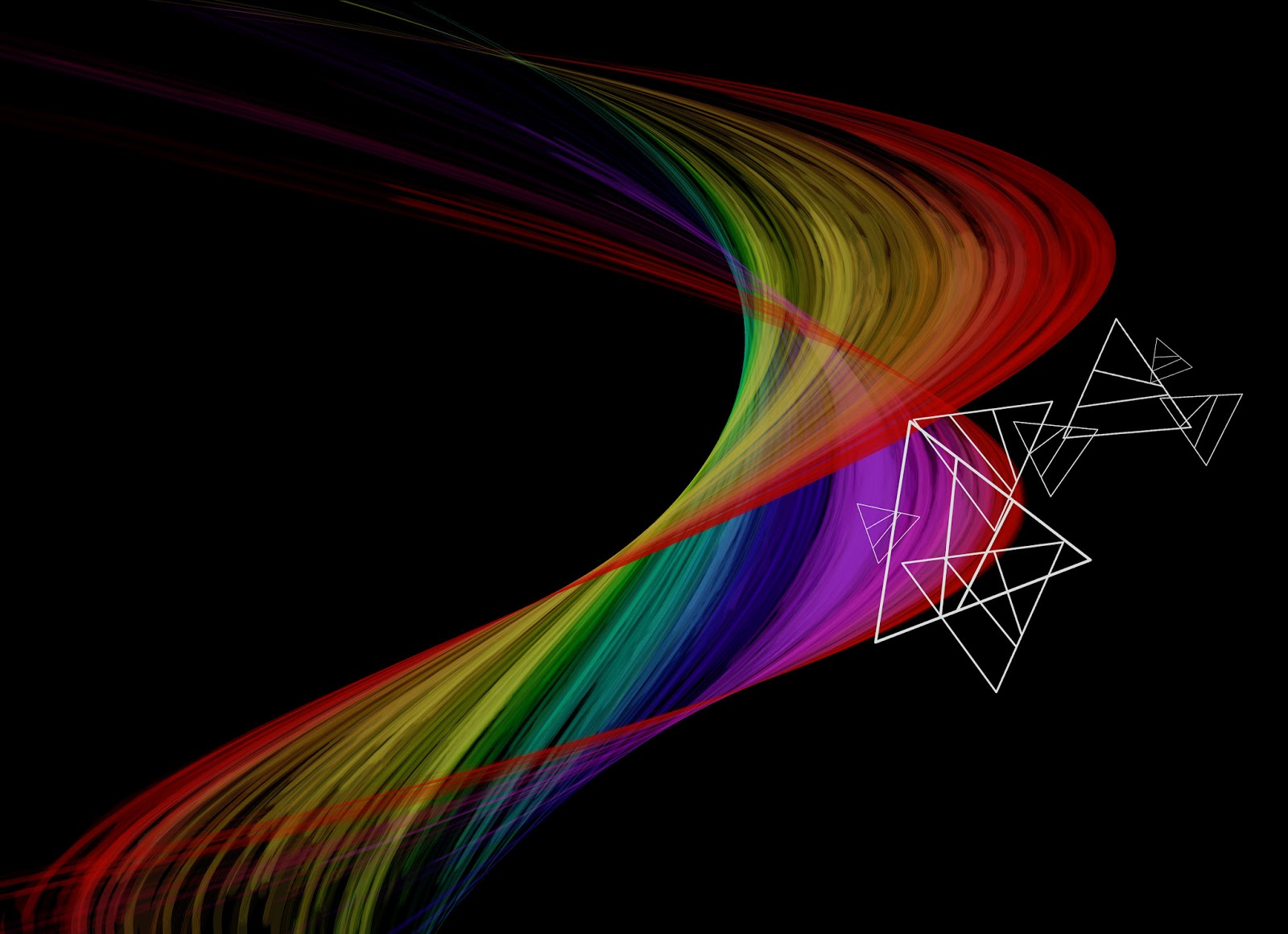
    As light is a spectrum of colours the colour theme is very wide so I have picked out the shape of the prism that separates the colour in light as a motif.