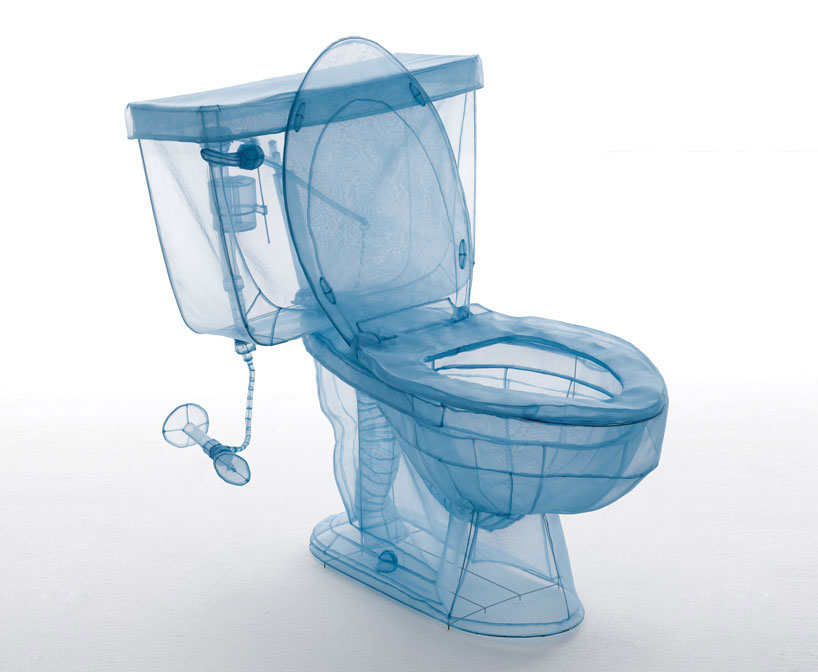
Thursday, 17 October 2013

Do Ho Suh Lehmann Maupin

Image © do ho suh courtesy the artist and lehmann maupin, new york and hong kong
photo by taegsu jeon

"korean artist do ho suh presents his first solo exhibition at lehmann maupin gallery in hong kong, a site-specific installation of sculptural artworks. the collection is a continuation of his new york specimen series, which designboom previously covered here, and consists of six life-size replicas of various household appliances from his personal apartment on west 22nd street in manhattan. a bathtub, toilet, medicine cabinet, radiator, kitchen stove and refrigerator are all structurally rendered in full-scale, using the artist’s signature polyester material. the near-translucent fabrications reveal each item’s inner workings, exposing the technical, semi-architectural framework of their build. the almost weightless wire structures are an extension of his study of themes surrounding cultural displacement, the establishment of relationships within new environments, and memories as both physical and metaphorical manifestations."

This work reminds me of  Macato Murayama's blueprint like Inorganic Flora flowers.
.

Tuesday, 15 October 2013

Macoto Murayama

 
Image from : http://blogs.smithsonianmag.com/artscience/2013/05/macoto-murayamas-intricate-blueprints-of-flowers/

Inorganic Flora for Corporate Video of Panasonic Hollywood Laboratory

Macoto Murayama cultivates inorganic flora. First, he chooses the plant and finds the real flower, for example the exquisite Lathyrus odoratus L. Second, he dissects the flower cutting the petal and ovary with scalpel and observes it with magnifying glass. Third, he makes sketches and photographs the parts of dissected flower. Forth, he models its form and structure using 3ds Max (3DCG software). Fifth, he renders separate parts and creates a composition using Adobe Photoshop. Sixth, he imposes admeasurements, parts names, scale, scientific name etc. Seventh, he prints out Lathirus odoratus L. at large scale printer and frames it... Here it is, The Flower of Totalitarian Scientific Conscious: properly fixed, totally measured, strictly nominated and distinctly shown. It is not only an image of a plant, but representation of the intellect’s power and its elaborate tools for scrutinizing nature. The transparency of this work refers not only to the lucid petals of a flower, but to the ambitious, romantic and utopian struggle of science to see and present the world as transparent (completely seen, entirely grasped) object. Paradoxically, this scientific challenge to measure the Universe might eventually become one of the sources where art of Murayama draws its strength of fantasy and odor of romanticism, becoming a part of Botech Art, symbiosis of Botanical Art and Technology.

Portia Munsoneti

Portia Munsoneti began creating flower images in 2002 after the death of a close person left her pondering the fleeting lives of flowers and people.
"While walking in my garden images of flower arrays came to me. I imagined flower mandalas that were reminiscent of suzanies from Uzbekistan and the vivid garlands of fresh blossoms I had seen used as religious offerings in Thailand. Using the mandala, the circular form that in Eastern religions represents the universe, I meticulously arrange flowers from the garden into combinations of color and form that exaggerate the vibrancy of both. Sometimes I slice into buds and append blossoms onto one another. As with all my work, a closer look at the subject reveals hidden secrets – in this case, the flowers’ hairy, sticky, or poisonous parts; pollen; seeds; and the occasional insect.
To make these mandala images, I use the scanner like a large-format camera. I lay flowers directly onto it,
allowing pollen and other flower stuff to fall onto the glass and become part of the image. When the high-resolution scans are enlarged, amazing details and natural structures emerge. Every flower mandala is unique to a moment in time, represents what is in bloom on the day I made it."

I enjoy how Munsoneti includes animals in some of her pieces as I was looking for how other artists, include and represent death in their work.

Tuesday, 8 October 2013

Paper illusions

Artist and designer Isabelle de borchgrave creates paper dresses inspired by the early twentieth century all out of paper. 


Monday, 7 October 2013

Textiles and Interpretations of Death

Textile Patterns by "Hacking Cameras to Death"


When a computer starts acting up, slowing down, or otherwise interrupting the preparation of an important presentation, most people get frustrated, but artist Phillip Stearns gets inspired and has created a line of textiles based on the patterns that emerge when electronics overheat, freeze up, or otherwise crap the bed.


http://www.wired.com/design/2013/08/glitch-textiles/#slideid-203841


Recycling the Dead


Kerry Greville believes that the human body has resource potential after death. The Central Saint Martins student, who's pursuing a master's degree in textile futures, is exploring the provocative notion that we can—and should—extract chemical components from cremated remains


http://www.ecouterre.com/recycling-the-dead-proposes-textile-products-from-cremated-remains/

Sylvia Ji weaves textiles into her beautiful Mexican death obsession...

The Day of the Dead looms large in these macabre yet strangely attractive acrylic on wood paintings, but with Interwoven Ji has moved away from the traditional dress and colonial era ballgowns of her previous collections, introducing shawls and blankets as a distinct but organically enmeshed element. This series also sees more abstract work, with camouflaged skulls made of petals, leaves, birds and animals gently pushing out at the viewer from a nearly continuous background with the effect of an optical illusion, hinting at the decay in nature and the transience of beauty.

Sol de Oro
acrylic and gold leaf on wood panel, framed
36″ x 24″


Susan Silas Dead Bird Photography

COURTESY // ARTILLERY MAG

“Dead birds can be an endless source of fascination. Throughout history, birds have occupied prominent and diverse roles in art, folklore, religion and popular culture. In religion for example, birds have served as either messengers or priests for a deity, such as in the Cult of Make-make on Easter Island where the Tangata manu (bird-man) presided over a competition to deliver the first Sooty Tern egg of the season to the village of Orongo.
Susan Silas, in her most recent exhibition at CB1 Gallery has cast herself both as a modern day purveyor of bird lore and a shaman of bird dreams, documenting through a series of remarkable photographs the process by which these creatures slowly decay and return to the earth…The fact she has chosen to document them in various stages of decomposition speaks directly to our own human need to understand the death process, and ultimately, or more profoundly, to attempt to arrest and control the mysterious and the unknown.”
 
http://www.spiritofspider.com/2011/11/shaman-of-bird-dreams-susan-silas-dead-bird-photography/